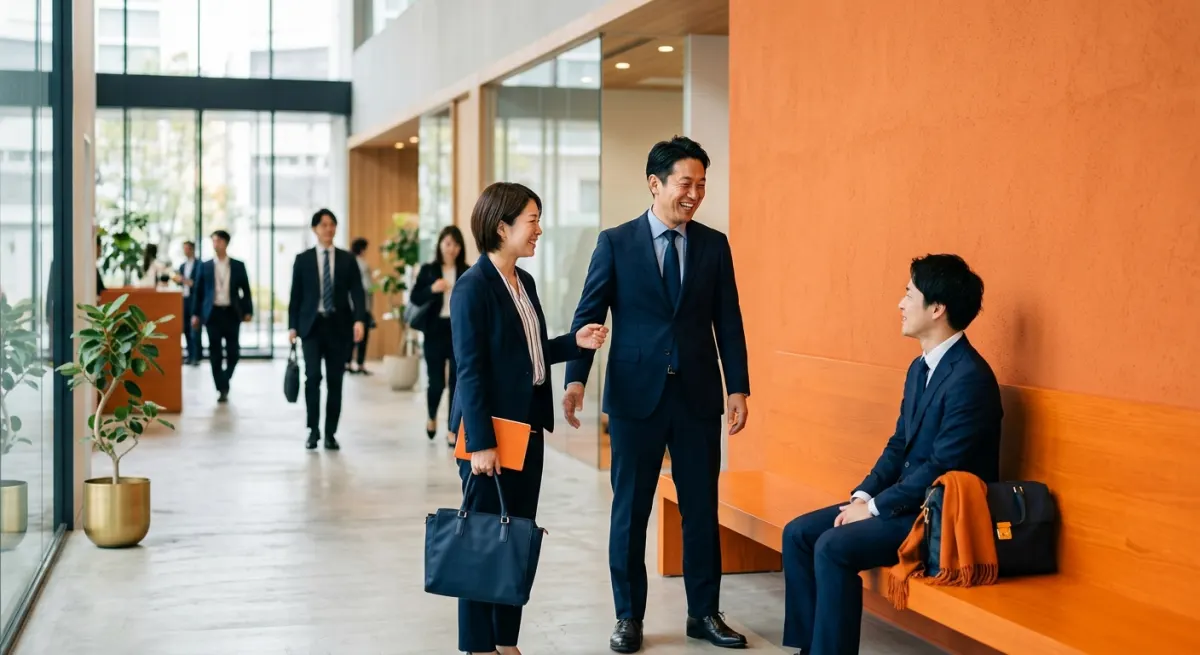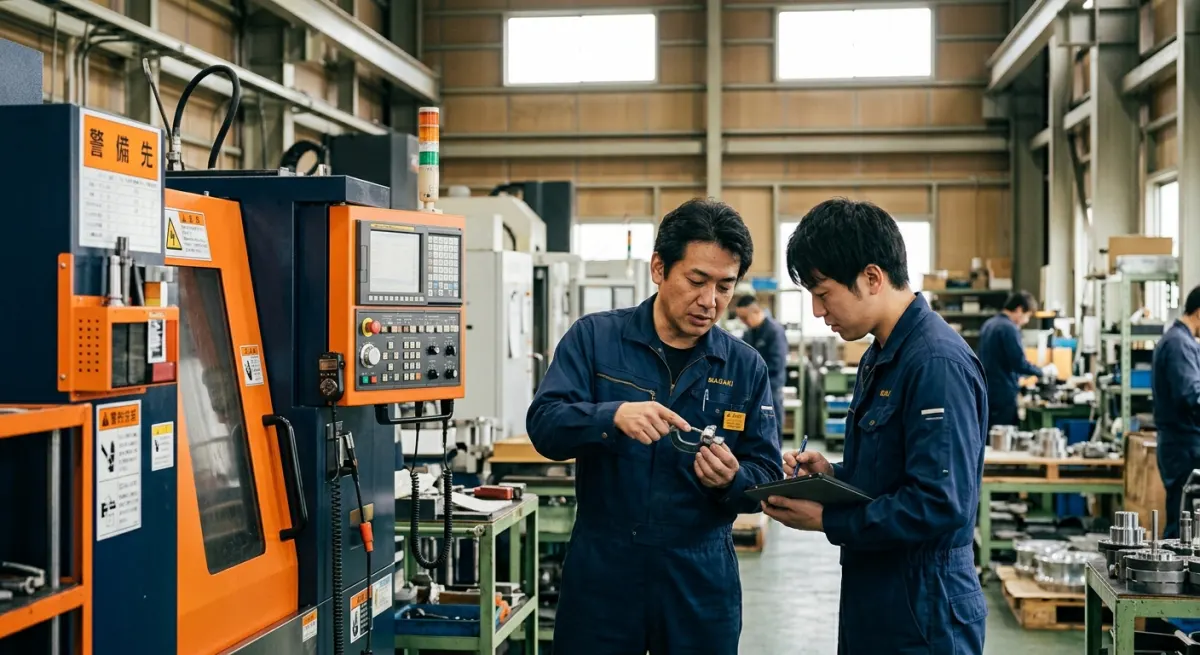
Japanese Work Culture: What European Companies Get Wrong
How Japanese work culture actually operates, hierarchy, decision-making, communication, and working hours, explained for European companies preparing for Japan engagement.
Part of our Cross-Cultural Leadership series. Start with the full guide: Japanese Business Culture: A Working Guide for Europeans
- Japanese work culture is internally coherent and operationally efficient on its own terms, but those terms differ from European defaults in specific, identifiable ways
- Hierarchy is structural, not symbolic: it determines who speaks, who decides, and in what order
- Decisions are made before meetings through nemawashi (informal consensus-building), not through in-room debate
- Post-2018 overtime reform has changed hours but not the underlying logic, visible commitment still matters
- The Hofstede masculinity gap between Japan (95) and the Netherlands (14) is one of the widest in any bilateral pair, making Dutch-Japanese collaboration particularly friction-prone without preparation
Most European briefings on Japanese work culture start with a list. Ten things to know. Five surprises. A catalogue of oddities, the bowing, the business cards, the long hours, presented as though understanding Japan is a matter of memorising rules.
Japanese work culture is a system. Its components interact. Hierarchy shapes communication, communication shapes decision-making, decision-making shapes how time is spent, and how time is spent reinforces hierarchy. Pull one thread and the rest moves with it.
What follows is a working brief for European companies, particularly Dutch, German, and Scandinavian firms, preparing to work with Japanese organisations. It covers how the system actually operates, where it collides with European assumptions, and what to do about the friction. The perspective comes from eight years of cross-cultural growth marketing between the EU and Japan, including work delivered as an EU-Japan Centre for Industrial Cooperation expert.
What "Japanese work culture" means in practice
The phrase gets used loosely. For European executives planning Japan engagement, it refers to three operational realities that shape every interaction:
Hierarchy as structure. In most European organisations, hierarchy exists but is negotiable. A junior employee with a good idea can pitch it directly to a director. In many Dutch companies, the intern can disagree with the CEO in a meeting and be praised for it. Japanese organisations do not work this way. Hierarchy determines who speaks, who listens, who proposes, and who approves. It is how things flow.
Communication as protocol. What gets said, when, by whom, and in what form is governed by position, relationship, and context. It is an information-routing system. A message delivered by the wrong person, at the wrong time, or in the wrong format will not land, regardless of its content.
Time as relationship signal. Hours spent, presence maintained, and responsiveness demonstrated do more than track productivity. They are signals of commitment to the group. A European manager who leaves at 17:30 because the work is done sends a different message than they intend. In a Japanese context, departure before your seniors signals something about your relationship to the team, not your efficiency.
These three elements are facets of one operating logic. European companies that treat them as a checklist of cultural quirks will keep running into the same problems.
How the organisation operates
Seniority: senpai-kohai
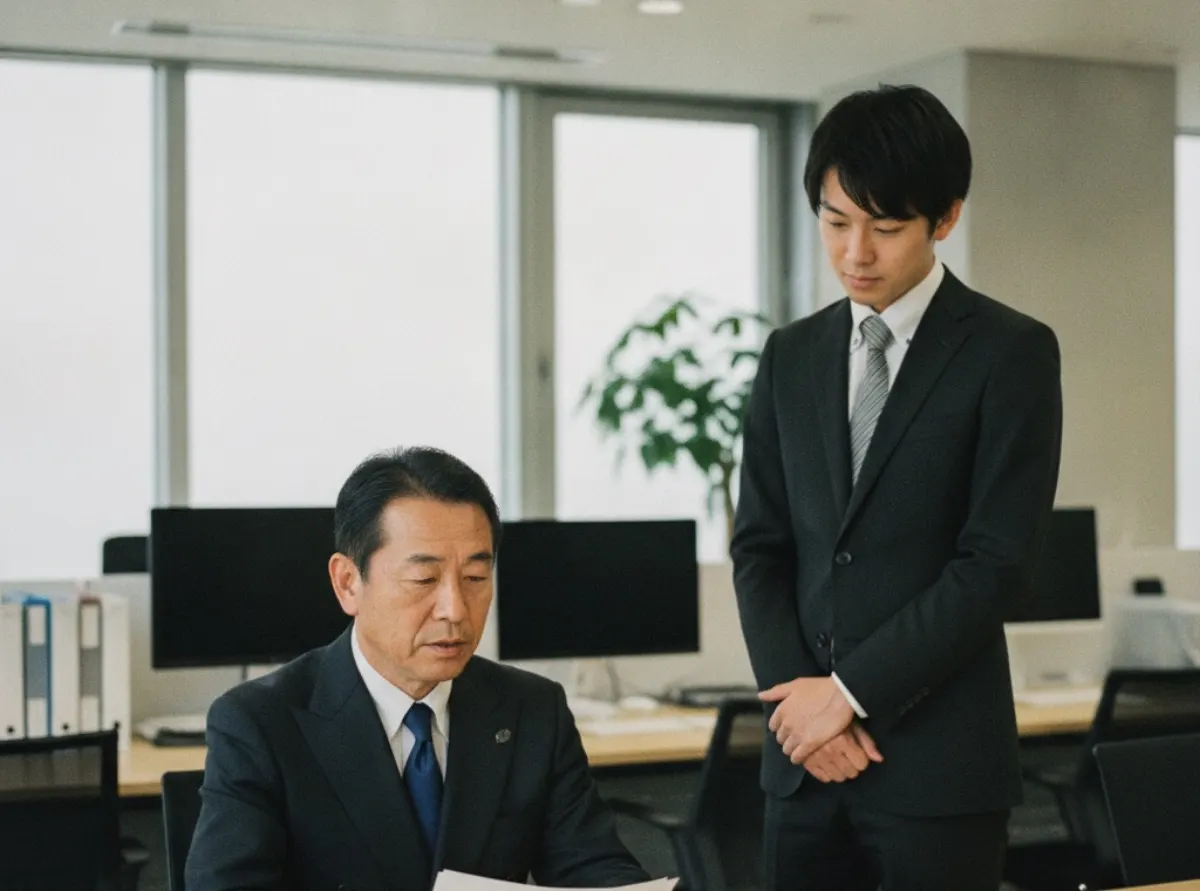
The senpai-kohai relationship (senior-junior) turns on who entered the organisation first, more than on age or title. Two employees hired in different years, even if they hold the same title, have a defined senior-junior relationship. The senpai has informal authority, mentorship responsibility, and social priority. The kohai defers, asks for guidance, and does not publicly contradict.
This runs deeper than reporting lines. In a European company, a lateral hire from outside might outrank someone with ten years of tenure by virtue of title alone. In a Japanese company, that lateral hire would need to work through a web of senpai-kohai relationships that the org chart does not show. Ignoring those relationships does not just create awkwardness. It blocks information flow, because people will not share openly with someone who has not earned relational standing.
For European companies with Japanese subsidiaries or joint ventures, this has a direct operational implication: placing a European executive above established Japanese staff without allowing time for relationship-building creates a structural communication gap. The European sees an org chart. The Japanese team sees a stranger who has not yet earned the right to receive candid information.
Structural hierarchy
Beyond senpai-kohai, formal hierarchy in Japanese companies tends to be steeper and more consequential than in flat European organisations. The typical chain runs from bucho (department head) through kacho (section chief) to kakaricho (subsection chief) and then staff. Each level has defined authority over decisions, information access, and external communication.
Two things surprise European managers:
First, the levels are not ceremonial. A kacho cannot approve what a bucho must approve, even if the kacho has the expertise and the bucho does not. Authority is positional, not competence-based. This is a system designed for group accountability rather than individual initiative.
Second, skip-level communication is rare and noticed. In a Dutch company, emailing someone two levels up is normal. In a Japanese company, it can be read as a sign that you do not trust or respect your direct superior. Information flows up through each level, and each level adds context, filters, or framing before passing it on. European executives who bypass this chain, intending efficiency, often find that their message arrived but produced no response. The response was blocked, not by disagreement, but by protocol violation.
Decision-making: nemawashi and ringi
If there is one thing European companies need to understand about Japanese work culture, it is this: decisions are made before meetings, not in meetings.
The process has two components.
Nemawashi (literally "going around the roots") is the informal, one-on-one consultation that happens before any formal proposal. The person proposing an idea meets individually with every stakeholder, starting with the most junior and working up, to explain the idea, hear concerns, adjust the proposal, and build agreement. By the time the formal meeting happens, everyone in the room has already been consulted. The meeting exists to confirm, not to decide.
Ringi is the formal documentation system that follows. A proposal document (ringisho) circulates through the organisation, collecting stamps (hanko) of approval from each relevant manager. The ringisho moves upward through the hierarchy, and each stamp represents not just awareness but agreement. If someone has a concern, the document stops until the concern is resolved.
Together, nemawashi and ringi create a decision-making system that looks slow on the front end and fast on the back end. European companies, accustomed to deciding quickly in a meeting and then spending months on implementation and buy-in, often find the Japanese timeline frustrating. But the Japanese approach front-loads the buy-in. Once a decision clears ringi, execution is immediate because everyone has already agreed.
For a deeper treatment of these processes, see our dedicated guides on nemawashi and the ringi approval system.
The practical implication for European companies: do not try to get a decision in a meeting with a Japanese partner. Use the meeting to present information. Then give the Japanese side time to run nemawashi internally. Pushing for an answer in the room will not produce a faster outcome. It will produce a polite deflection ("we will consider it") that European executives often misread as indecision.
Communication style
High-context communication
Japan is one of the highest-context communication cultures in the world. What this means in practice: the words themselves carry less of the message than the context in which they are delivered, who is speaking, to whom, in what setting, at what point in the relationship, and what has been said (or not said) before.
For European business communication, which tends toward explicit, written, direct, "say what you mean and mean what you say", this creates a specific failure mode. European managers take Japanese responses at face value. When a Japanese counterpart says "that will be difficult" (muzukashii desu), the European hears "there are obstacles but it is possible." The Japanese speaker meant "no."
Common phrases that do not mean what Europeans think they mean:
- "We will consider it" (kentou shimasu), often means "this is not going to happen"
- "That is interesting" (omoshiroi desu ne), acknowledgement, not endorsement
- "It is a little..." (chotto...), a soft refusal
- "Yes" (hai), means "I hear you," not "I agree"
Honne and tatemae
The distinction between honne (true feelings) and tatemae (public presentation) is a communication architecture. Tatemae is the socially appropriate response, what you say in a meeting, in public, or to someone you do not know well. Honne is what you actually think, and it emerges only in trusted relationships, often outside formal settings, over drinks, in one-on-one conversations, or after years of working together.
European executives who mistake tatemae for agreement will discover, sometimes months into a project, that their Japanese partners had reservations they never voiced in meetings. This reflects a system where preserving group harmony (wa) takes priority over individual expression. The information was available, but it was encoded differently than Europeans expected.
Silence as signal
In European meetings, silence after a question is uncomfortable. Someone fills it. In Japanese meetings, silence is functional. It means the question is being considered. Rushing to fill it, or worse, rephrasing the question as though it was not understood, is read as impatience or lack of respect for deliberation.
A practical rule: when working with Japanese colleagues, wait at least ten seconds after asking a question before following up. This feels unnatural for most European communicators. It is necessary.
Working hours and reform
What the numbers say
The question "how many hours a day do Japanese work?" has a complicated answer.
The legal standard workweek in Japan is 40 hours, eight hours per day, five days per week. This is comparable to most European countries. The 2018 Work Style Reform Act (hataraki-kata kaikaku) introduced binding overtime caps for the first time: 45 hours per month and 360 hours per year as the baseline, with a maximum of 100 hours in any single month during busy periods. Companies that exceed these caps face penalties.
Before 2018, overtime was effectively unlimited. The legal framework allowed employers and unions to negotiate "Article 36 agreements" (saburoku kyotei) with no hard ceiling. The reform was triggered by high-profile cases of karoshi (death from overwork), including the 2015 case of a 24-year-old Dentsu employee whose death was ruled work-related.
By the numbers, average annual working hours in Japan have been falling for two decades. OECD data shows Japan at approximately 1,607 hours per year in 2023, below the United States (1,811) and roughly comparable to Italy (1,694), though still above the Netherlands (1,417) and Germany (1,341). The "Japanese workers never stop working" narrative is outdated in aggregate, but the averages mask significant variation by industry, company size, and generation.
The underlying logic
What the reform has not changed is the cultural logic underneath the numbers. Visible commitment, being present, being available, being seen to work, remains a career signal in many Japanese organisations, particularly traditional ones. In a system built on group accountability and long-term employment (though lifetime employment is declining, the cultural imprint remains), your reliability as a team member is partly judged by your visible investment of time.
A younger generation of Japanese workers is pushing back. "Work-life balance" (often rendered in Japanese as waku-raifu-baransu, borrowed directly from English) is a stated priority for workers under 35, and companies competing for talent in a shrinking labour market are adjusting. But the adjustment is uneven. Tech startups in Tokyo operate differently from manufacturers in Nagoya. Consulting firms differ from government agencies.
For European companies with Japanese operations, the practical question is not "how many hours should we expect our Japanese staff to work?" It is "how do we create an environment where working hours align with European standards without inadvertently signalling that we do not value commitment?" This is a genuine management challenge, and it requires more nuance than simply applying European HR policy to a Japanese office.
The meeting
Japanese business meetings are not what European executives expect, and the mismatch causes consistent problems.
Purpose
In most European contexts, meetings are decision-making forums. You present information, discuss it, debate it, and leave with an action plan. Japanese meetings (kaigi) serve a different function: they are confirmation events. The decision has already been made through nemawashi. The meeting exists to formally acknowledge it, to ensure everyone hears the same thing at the same time, and to create a shared record.
This means the European executive who arrives at a meeting ready to negotiate in real time is operating on wrong assumptions. The Japanese participants have already aligned internally. They are not going to change direction because someone makes a persuasive argument in the room. Persuasion happened earlier, in the nemawashi phase. The meeting is the endpoint, not the starting point.
Who speaks when
Speaking order in a Japanese meeting follows hierarchy. The most senior person speaks last, after everyone else has contributed. This is the opposite of many European meeting styles, where the most senior person often opens with their perspective and then asks for input.
The Japanese approach has an operational logic: if the boss speaks first, subordinates will not contradict. By having the most junior people speak first, the group captures a wider range of information before the senior perspective closes the discussion.
European managers who lead meetings with their opinion, intending to set direction, will find that their Japanese colleagues agree politely and contribute nothing further. The meeting looks efficient. It actually produced no new information.
Seating matters
In a Japanese meeting room, seating is not random. The kamiza (upper seat, farthest from the door) is for the most senior person or the most honoured guest. The shimoza (lower seat, closest to the door) is for the most junior person or the host. This is not trivia. Getting it wrong signals either ignorance or disrespect, and Japanese counterparts will notice even if they do not say anything.
For European companies hosting Japanese delegations: check seating arrangements before the meeting. For visits to Japanese offices: let your Japanese hosts guide you to your seat.
How this differs for European companies specifically
The friction between Japanese and European work culture is not generic. It has specific, measurable dimensions, and some bilateral combinations produce more friction than others.
Hofstede dimensions
Geert Hofstede's cultural dimensions framework, developed at IBM in the 1970s and refined over four decades, provides the most widely-used quantitative comparison. For Japan and the Netherlands, the bilateral pair most relevant to Silkdrive's work, the gaps are striking:
| Dimension | Japan | Netherlands | Gap |
|---|---|---|---|
| Masculinity (achievement vs care) | 95 | 14 | 81 |
| Uncertainty Avoidance | 92 | 53 | 39 |
| Long-Term Orientation | 88 | 67 | 21 |
| Individualism | 46 | 80 | 34 |
| Power Distance | 54 | 38 | 16 |
The masculinity gap of 81 points is one of the widest in any bilateral pair globally. Japan scores 95, the highest of any country, meaning the culture strongly values achievement, competition, and material success. The Netherlands scores 14, among the lowest, reflecting a culture that values quality of life, consensus, and modesty. This single dimension explains a disproportionate amount of the friction in Dutch-Japanese partnerships: Dutch directness ("just tell me what you think") meets Japanese indirectness ("let me consider the group's position").
Germany (66 masculinity) and the Scandinavian countries (Sweden 5, Norway 8, Denmark 16) each create their own specific friction patterns with Japan, but the Dutch-Japanese gap is particularly acute because both countries are economically significant partners. The Netherlands is Japan's number-one EU investment destination, and Japan is one of the largest Asian investors in the Netherlands. The volume of bilateral business means these cultural gaps surface constantly.
Specific friction points
Dutch-Japanese: The Dutch polder model (consensus through open debate) looks similar to Japanese consensus-building on the surface. Both cultures value agreement. But the mechanisms are opposite. Dutch consensus happens through explicit, sometimes blunt, open discussion. Japanese consensus happens through private, indirect, sequential consultation. A Dutch executive who tries to build consensus Japanese-style will feel slow and indirect. A Japanese executive exposed to Dutch-style debate will feel ambushed.
German-Japanese: German precision and process orientation often align well with Japanese attention to detail and procedural rigour. The friction point is flexibility. German planning is linear and documented, deviations require formal change management. Japanese planning includes more implicit adjustment, where the plan adapts through ongoing nemawashi without formal re-approval. German partners sometimes perceive this as disorganised; Japanese partners perceive German rigidity as inflexible.
Scandinavian-Japanese: The flattest organisational cultures in Europe meeting one of the steepest in Asia. Scandinavian first-name culture, open-door policies, and minimal status markers create a specific confusion for Japanese colleagues who need hierarchy signals to manage communication. Who do I report to? Who has authority? A Scandinavian "everyone is equal" ethos, genuinely intended, reads as ambiguity in a Japanese context.
What to do about it
Understanding the system is necessary but not sufficient. European companies engaging with Japan need practical mechanisms for working through the differences. Here are the interventions that produce the most measurable impact, based on what we see working across Silkdrive's client engagements:
Pre-assignment cultural briefings. Not a two-hour seminar about bowing. A structured programme that covers communication protocols, decision-making processes, and relationship-building timelines specific to your industry and the Japanese organisations you will be working with. Generic training wastes money. Targeted training prevents expensive mistakes. See our cross-cultural training programmes for the framework we use.
Relationship-building time in the project plan. European project timelines typically assume that collaboration starts on day one. In Japan, collaboration starts when the relationship is established, which takes weeks or months. Budget time at the front of any Japan engagement for dinners, site visits, informal meetings, and gradually building trust. This is the foundation that makes everything else possible.
Bilingual intermediaries, not just translators. Language translation handles words. Cultural translation handles meaning. A bilingual Japanese-European professional who understands both business cultures can tell you what your Japanese counterpart actually meant when they said "we will study it carefully" (they meant no). This role is more valuable than any amount of cultural training, because it operates in real time. Silkdrive's expert network includes professionals who serve this function across multiple industries.
Adapted meeting protocols. When running meetings with Japanese partners: circulate materials in advance (they need time for internal nemawashi), open with the most junior person's input rather than the senior leader's direction, allow silence after questions, and do not push for decisions in the room. Follow up with a written summary and give the Japanese side a defined timeline to respond through their internal process.
Patience with the decision timeline. The single most common frustration European companies report is the pace of Japanese decision-making. It feels slow. It is slow, on the front end. But decisions that clear the nemawashi and ringi process stick. They do not get relitigated. They do not face internal resistance during implementation. European companies that accept the front-end timeline consistently report faster overall project completion than those that try to force the European pace and spend months managing internal Japanese pushback.
Frequently asked questions
What is Japan's working culture like?
Japanese work culture operates on three interconnected principles: structural hierarchy (which determines who speaks, decides, and in what order), consensus-based decision-making (through nemawashi and ringi), and visible commitment (where presence and responsiveness signal group loyalty). It is internally coherent and operationally efficient, but its logic differs from European defaults in ways that require deliberate adaptation.
How many hours a day do Japanese work?
The legal standard is eight hours per day (40 hours per week). Since the 2018 Work Style Reform Act, overtime is capped at 45 hours per month and 360 hours per year in normal circumstances. Average annual working hours have been declining and are now comparable to southern European countries at approximately 1,607 hours per year (OECD 2023), though they remain above the Netherlands (1,417) and Germany (1,341).
Is Japanese work culture changing?
Yes, but unevenly. Post-2018 overtime reform, a tightening labour market, and generational shifts are driving change, particularly in urban areas and the tech sector. Workers under 35 cite work-life balance as a top priority. However, the underlying cultural logic of visible commitment, group accountability, and hierarchical communication remains strong, especially in traditional industries and established corporations.
How should European companies prepare for working with Japanese partners?
Start with targeted cultural training that goes beyond etiquette to cover decision-making processes, communication protocols, and relationship timelines. Build relationship time into your project plan. Use bilingual cultural intermediaries, not just translators. Adapt your meeting structure to allow for nemawashi. Accept the front-loaded decision timeline, it produces faster execution on the back end.
What is the biggest mistake European companies make in Japan?
Assuming that their existing operating model will transfer. European companies default to direct communication, fast decisions, individual accountability, and flat hierarchies. Japanese organisations operate on indirect communication, consensus decisions, group accountability, and steep hierarchies. The mistake is structural incompatibility that goes unaddressed because the differences are subtle enough to miss until they compound into project failure.
Related Resources
- Japanese Business Culture: A Working Guide, The broader framework covering business etiquette, cultural concepts, and operational differences across all layers of Japanese business engagement
- Nemawashi: How Japanese Companies Actually Make Decisions, An in-depth look at the informal consensus-building process that determines outcomes before any meeting happens
- Ringi: The Japanese Approval System, How formal proposals circulate through Japanese organisations and what European companies need to know about the process
- Cross-Cultural Communication Training, Training frameworks for teams preparing for cross-border collaboration, with specific modules for EU-Japan engagement
- Japan-Netherlands Business Corridor, The bilateral trade and investment relationship, including the $190B+ combined FDI stock and what it means for Dutch companies
- Hofstede Dimensions in Digital Marketing, How cultural dimension scores translate into marketing strategy differences across the EU-Japan corridor
- Japan Market Entry Guide, Practical guide to entering the Japanese market, covering regulatory, partnership, and go-to-market considerations
Stay Ahead in Cross-Cultural Marketing
Get monthly insights on international growth strategies, cultural intelligence, and digital marketing trends delivered to your inbox.
We respect your privacy. Unsubscribe at any time.